
Dermaplaning
What is it
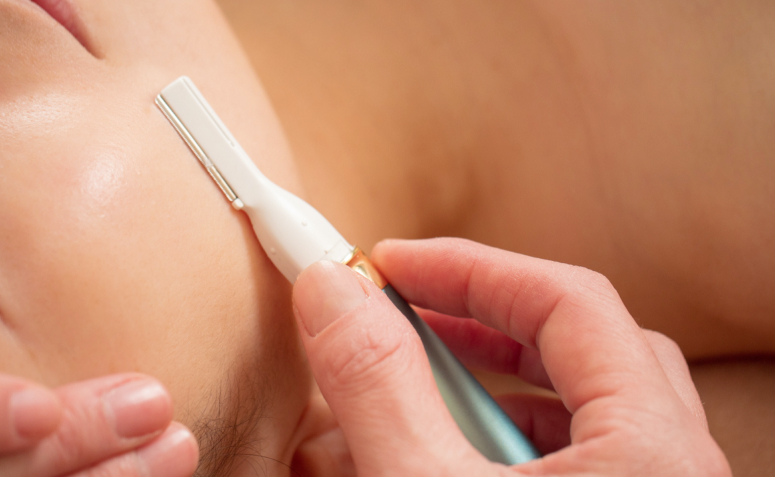
Dermaplaning is a superficial exfoliation, in which an ablation is performed with a scalpel blade, removing the stratum corneum (layer of dead cells) and hairiness from the skin, improving its texture and tone.
Indications
No information.
Benefits
The procedure helps promote skin rejuvenation, among other benefits:
Improves skin texture: increases skin radiance and luminosity.
Stimulates cell renewal: the treatment eliminates dead cells and facial fuzz.
Improves skin permeability: increases the effect of active ingredients due to the removal of the concentration of dead cells.
Facilitates makeup application: provides greater fixation and durability of makeup, in addition to leaving the skin with a more beautiful finish.
Promotes rejuvenation: the procedure improves fine lines and wrinkles.
Reduces the appearance of acne: reduces the clogging of the sebaceous glands by the superficial layer of keratotic cells.
Contraindications
faces with active acne
people who have sensitive skin, rosacea, psoriasis and dermatitis
who is allergic to nickel
Furthermore, the person should avoid exposure to the sun and stop acids five days before the procedure. Afterwards, one of the post-dermaplaning precautions is to avoid direct exposure to the sun for the next 48 to 72 hours.
There are also some side effects that can occur if the procedure is not carried out correctly and by those who do not know what dermaplaning is. Some of these effects are redness on the face or the development of blackheads and pimples.
How is done
The procedure is painless, however, as the technique uses a cutting blade.
First of all, it is important to highlight that this procedure must be done after deep skin cleansing.
Then, the professional should use the razor lightly and gently, which will help remove dead cells and hairiness (short hairs present all over the face) from the skin.
During this step, the professional can use an oil or moisturizer to help the blade glide, but this step is not mandatory.
Finally, moisturizing masks or creams are applied that have a calming effect, to avoid irritation, as well as a good sunscreen.
Peridity
The scalpel used in dermaplaning aims to remove dead skin from the face, improving its texture and tone. However, it cannot be done frequently.
Therefore, it is recommended to wait 21 days between one session and another, so that the skin can be renewed during this period.
Care
Dermaplaning is an aesthetic procedure that removes dead cells and fine hairs from the face using a sterilized blade, leaving the skin smoother, more uniform and better absorbing cosmetics. Although it is painless and superficial, the skin becomes temporarily more sensitive and vulnerable after the procedure.
Avoid touching your face excessively in the first few hours, as the pores will be more exposed and susceptible to the entry of impurities.
Do not apply makeup for the first 24 hours to allow the skin to breathe and prevent clogging of recently exfoliated pores.
Avoid sun exposure for at least 48 hours and use sunscreen with a high SPF, reapplying throughout the day. The skin will be more sensitive to UV radiation and prone to blemishes.
Do not use products with acids, retinoids, alcohol or exfoliants for at least 3 days after the procedure, to avoid burning, dryness or adverse reactions.
Intensely moisturize your skin with gentle, soothing products, such as those containing aloe vera, chamomile or panthenol.
Avoid activities that cause excessive sweating in the first 24 hours (such as going to the gym or sauna), as sweat can irritate newly treated skin.
Comments
No information.
Estimated time
60 minutes